I had a meeting last week with a client to review his custom wardrobe designs. We were looking at eyeglasses compartment inserts and comparing the standard sizes with the drawer widths in his particular closet to figure out how many eyeglasses he could store in the configuration the wardrobe designer was proposing.
He pulls out a pair of glasses from his pocket, folds them onto the table, and says "These are what, 9 or 10 inches wide?"
...
They were 5 inches wide, and it was all I could do to stop myself from laughing out loud.

Monday, September 24, 2018

Wednesday, August 22, 2018
What the...: An Ongoing Series
The kitchen consultant: "We want to make sure our client is ecstatic about the finished product."
~pregnant pause~
The architect: "I have a hard time imagining our client being ecstatic about anything. Maybe we should shoot for pleased, or satisfied."
Monday, August 13, 2018
What the... : An Ongoing Series
A thought that just passed through my mind about half an hour ago:
10am is too early for harmonicas in this office.
Tuesday, July 17, 2018
What the ...: An Ongoing Series
My colleague sent this image to me out of the blue with the caption: I'M COMING FOR YOU.
and all I could think was
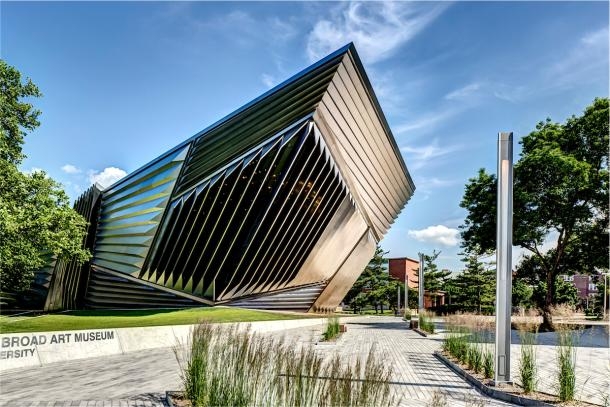 | ||||
| Eli and Edythe Broad Art Museum, by Zaha Hadid Architects |
and all I could think was
Thursday, July 12, 2018
Professional Correspondence: Part 5: "WHEN" and Review
This post continues from Professional Correspondence, Part 4: HOW.
(Lost? Start here, with Part 1: Professional Correspondence)
How many times have you sent or received business correspondence after 10pm? From someone ostensibly on vacation? Over the weekend? I’m working with a consultant now who habitually sends submittal responses after 11pm on a Sunday. This person is based in Chicago, not in Shanghai.
It is important to recognize that the timing of a message has meaning just like the content or the medium of the message. Habitually sending correspondence long after business hours, during vacation, or over the weekend sends the message that your work life has greater priority than the rest of your life, and sets expectations that you are “on call.”
(Lost? Start here, with Part 1: Professional Correspondence)
How many times have you sent or received business correspondence after 10pm? From someone ostensibly on vacation? Over the weekend? I’m working with a consultant now who habitually sends submittal responses after 11pm on a Sunday. This person is based in Chicago, not in Shanghai.
It is important to recognize that the timing of a message has meaning just like the content or the medium of the message. Habitually sending correspondence long after business hours, during vacation, or over the weekend sends the message that your work life has greater priority than the rest of your life, and sets expectations that you are “on call.”
Wednesday, July 11, 2018
Professional Correspondece: Part 4: "HOW"
This post continues from Professional Correspondence, Part 3: WHAT.
Marshall McLuhan coined the phrase “The medium is the message,” which appeared in his 1964 book “Understanding Media: The Extensions of Man.” McLuhan describes a message as “the change in scale or pace or pattern” introduced by a new invention or innovation. Look at how much communication has sped up and increased in volume with the wide adoption of email. It’s been ten years since the first iPhone made it possible to take and send high quality pictures from the same device. Can anyone here remember the last time they used a fax machine?
Marshall McLuhan coined the phrase “The medium is the message,” which appeared in his 1964 book “Understanding Media: The Extensions of Man.” McLuhan describes a message as “the change in scale or pace or pattern” introduced by a new invention or innovation. Look at how much communication has sped up and increased in volume with the wide adoption of email. It’s been ten years since the first iPhone made it possible to take and send high quality pictures from the same device. Can anyone here remember the last time they used a fax machine?
Tuesday, July 10, 2018
Professional Correspondence: Part 3: "WHAT"
This post continues from Professional Correspondence: Part 2: "WHO"
Now let's talk about WHAT: the actual content of the correspondence.
Most face-to-face meetings and telephone calls will have preliminary small-talk: how are you, how’s your family, do you have plans for the weekend, etc. This is the social “grease” to maintain a smooth relationship with people. In contrast, business writing is more brief. Effective correspondence in a business setting gets to the point right away, and makes clear the call to action to get efficient results. This is different from a lot of the typical writing models taught in school, and different from how one would correspond with friends and family. Teaching the difference is critical to promote writing that gets results.
Now let's talk about WHAT: the actual content of the correspondence.
Most face-to-face meetings and telephone calls will have preliminary small-talk: how are you, how’s your family, do you have plans for the weekend, etc. This is the social “grease” to maintain a smooth relationship with people. In contrast, business writing is more brief. Effective correspondence in a business setting gets to the point right away, and makes clear the call to action to get efficient results. This is different from a lot of the typical writing models taught in school, and different from how one would correspond with friends and family. Teaching the difference is critical to promote writing that gets results.
Subscribe to:
Posts (Atom)